Blog
Notes from Loka
Practical guides on AI meetings and productivity, plus the story behind how Loka is built.
Burmese Speech to Text in 2026: What Accuracy Really Looks Like
Off-the-shelf Whisper returned empty transcripts on 28 of 30 clean Burmese clips in one test. Here is what fine-tuned models achieve, why CER matters, and how to test before you commit.
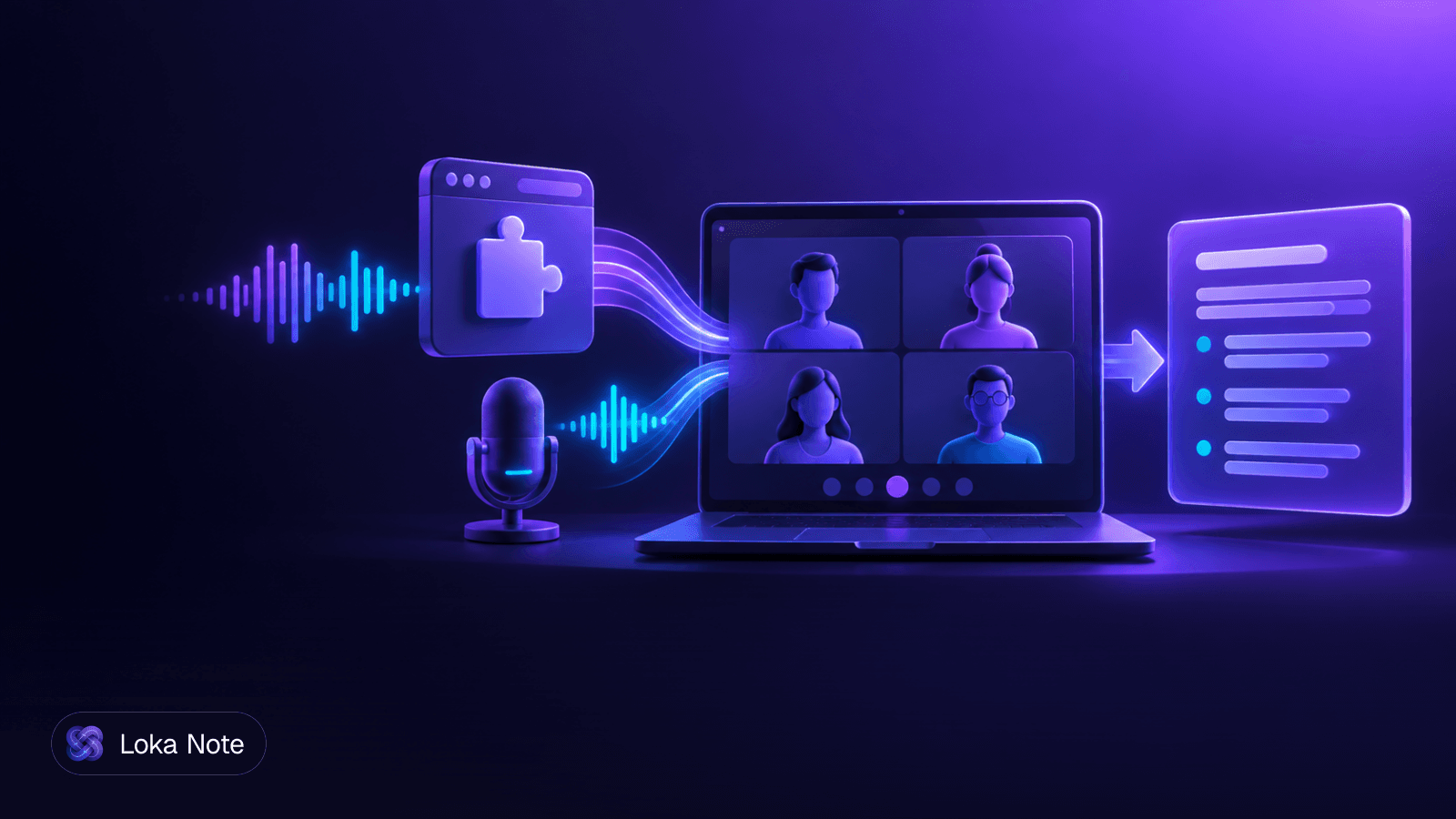
Browser Extension Meeting Recorder: How It Works Without a Bot
A browser extension meeting recorder captures the audio your browser already plays and your microphone, so no bot joins the call. Here is how it works, where the audio goes, and what to check.
Google Calendar Meeting Notes Automation: 3 Ways to Set It Up
Google Docs can attach a blank notes template to an event, but it will not write the summary. Here are three ways to automate notes on Google Calendar events, and where each one breaks.

Voice Note to Text in Nigerian English: 6 Options Compared
Standard speech-to-text often struggles with Nigerian accents, phone-quality audio and mid-sentence switches into Pidgin, Yoruba or Hausa. Here is what to use instead, what it costs, and how to test it.
AI Chat With Meeting Transcripts: What to Ask and What to Check
AI chat lets you ask a transcript questions instead of rereading it. Here is how it works, which features matter, how to catch wrong answers, and what changes for multilingual teams.
Fathom AI Alternative: 7 Options for Multilingual Meetings
Fathom works well for English video calls. If your meetings mix languages or happen in person, these alternatives differ on language depth, code-switching, capture method and price.
Chinese Speech to Text Free Online: 7 Tools for Mandarin Audio
Seven free Mandarin transcription tools compared by allowance, signup, privacy and output, plus how to avoid tone, dialect and Simplified/Traditional errors.
Transcribe Google Meet Without a Bot: 4 Methods That Work
You can transcribe a Google Meet call without an AI bot joining. Here are four methods, what each one needs, where each one breaks, and how to handle consent and mixed-language meetings.
Otter vs Fireflies: Pricing, Languages, Privacy and CRM Compared
Otter is built around live capture and Fireflies around workflow and CRM sync. We compare pricing, seat minimums, languages and data policy, and show where both fall short for multilingual teams.
Pay as You Go Audio Transcription: 9 Tools Priced per Hour
Nine pay-as-you-go transcription tools compared on hourly rate, minimum fees, credit expiry and free trials, with break-even math against a $16.99 monthly plan.
Transcribe Video to Text: Audio Tricks for Slow Connections
Transcription tools only read the audio in your video. Here is how to use that to upload less, pick TXT or SRT correctly, and fix errors from accents and mixed languages.
Are AI Note Takers Safe? 10 Questions to Ask Before You Record
Encryption is the easy part. The real exposure with AI note takers is consent law, retained transcripts, model training and who else touches your audio.
Qualitative Research Interview Transcription Without Losing Weeks
Typing interviews by hand can cost 3 to 10 hours per hour of audio. Here is a workflow that pairs a machine draft with structured checking, so your transcripts stay defensible and your timeline stays intact.
Interview Transcription: Styles, Formatting and a Two-Pass Check
How to choose a transcription style, format speaker labels and timestamps, verify an AI draft in two passes, and handle anonymization and mixed-language audio.
How to Transcribe Audio to Text: 5 Methods Compared (2026)
Five ways to turn a recording into text: typing, Word, cloud AI, local models and human transcribers. Costs, privacy trade-offs, and what to fix before you start.
Sales Call Notes: What to Capture, What to Skip, How to Automate
Capture raw signals during the call, clean them up in ten minutes, and let AI draft CRM updates that a rep confirms. Includes a template and advice for mixed-language calls.
Action Items From Meetings: How to Capture Them So They Get Done
Most action items die in the meeting notes. Here is a five-part formula, a read-back routine and a 10-minute rule that move tasks from conversation into the tools where work happens.
How to Take Meeting Notes That Get Read and Acted On
Good meeting notes are short: decisions, one owner per action, and open questions. Here is a two-pass method, the phrases to listen for, and a template you can copy.
How to Summarize a Zoom Meeting: AI and Manual Methods
Three ways to summarize a Zoom meeting: Zoom's built-in AI, a transcript run through another tool, or a manual 7-step method. Includes fixes for the gaps AI summaries leave.
Multilingual Meeting Transcription: What Actually Works
AI can transcribe meetings in two languages, but 'multilingual' on a feature list can mean four different things. Here is what each one delivers, where it breaks, and how to work around it.
Meeting Minutes Template: 4 Formats You Can Copy and Use
A good meeting minutes template has seven core sections and keeps discussion, decisions and action items apart. Four copy-and-paste formats and a list of what to cut.
How to Write Meeting Minutes: Steps, Examples and Templates
Good minutes record what a meeting decided, who owns what and by when, not who said what. Here is the workflow, the wording rules and two templates you can copy.
How to Transcribe Google Meet: Steps, Limits and Fallbacks
Google Meet has a built-in transcript, but only on certain Workspace plans and in eight languages. Here are the exact steps, where the file goes, and what to do when the button is missing.
tldv Alternative: 10 Tools for Private Meeting Notes
Ten tl;dv alternatives compared on bot-free capture, privacy, price and language support, from open-source local recorders to cloud tools.
Meeting Transcription Without Bot: How It Works and What to Check
You can transcribe Zoom, Meet and Teams calls without a bot in the participant list. Here is how capture works, where it fails, what the law still requires, and how language support changes the choice.
AI Meeting Notes Without Subscription: What Actually Stays Free
Most free AI note takers cap you by meeting count, minutes or history. Here are the three ways to get meeting notes without a monthly bill, and the limits of each.
Granola Alternatives for Multilingual and Mixed-Language Meetings
Granola is a good notepad, but its language coverage, jargon handling and audio policy trip up multilingual teams. Here is how six alternatives compare, and how to choose.
Fireflies AI Alternatives Without a Bot: What to Check
Bot-free recording is now standard, so it no longer separates tools. Pricing, where your audio goes, platform limits and language support do. Here is how the main options compare.
AI Note Taker for Burmese: Tools Compared for Mixed Meetings
Most tools list Burmese as supported. Few say how they handle Burmese-English code-switching, speaker labels or offline use. Here is how six options compare on what the sources document.
Why Burmese-English Code-Switching Breaks Transcription Tools
Most transcription tools fail on Burmese meetings where English terms appear mid-sentence. Here is why it happens, how to measure it, and what helps.
Myanmar Meeting Minutes: Legal Rules and a Bilingual Template
Myanmar meeting minutes must go into the minute book within 21 days and be signed by the right person. Here is what to record, how to handle Burmese and English, and what happens if you don't.
Otter AI Alternative for Teams That Switch Languages Mid-Meeting
Otter.ai covers six languages and expects one per recording. Here is how Fireflies, Notta, Fathom, tl;dv and Loka Note compare for teams that mix languages, plus a way to test them.
How to Transcribe Burmese Audio Accurately, Step by Step
Generic speech models still make many errors on Burmese. Here is how to prepare audio, pick an engine, fix Unicode problems, and measure accuracy honestly.