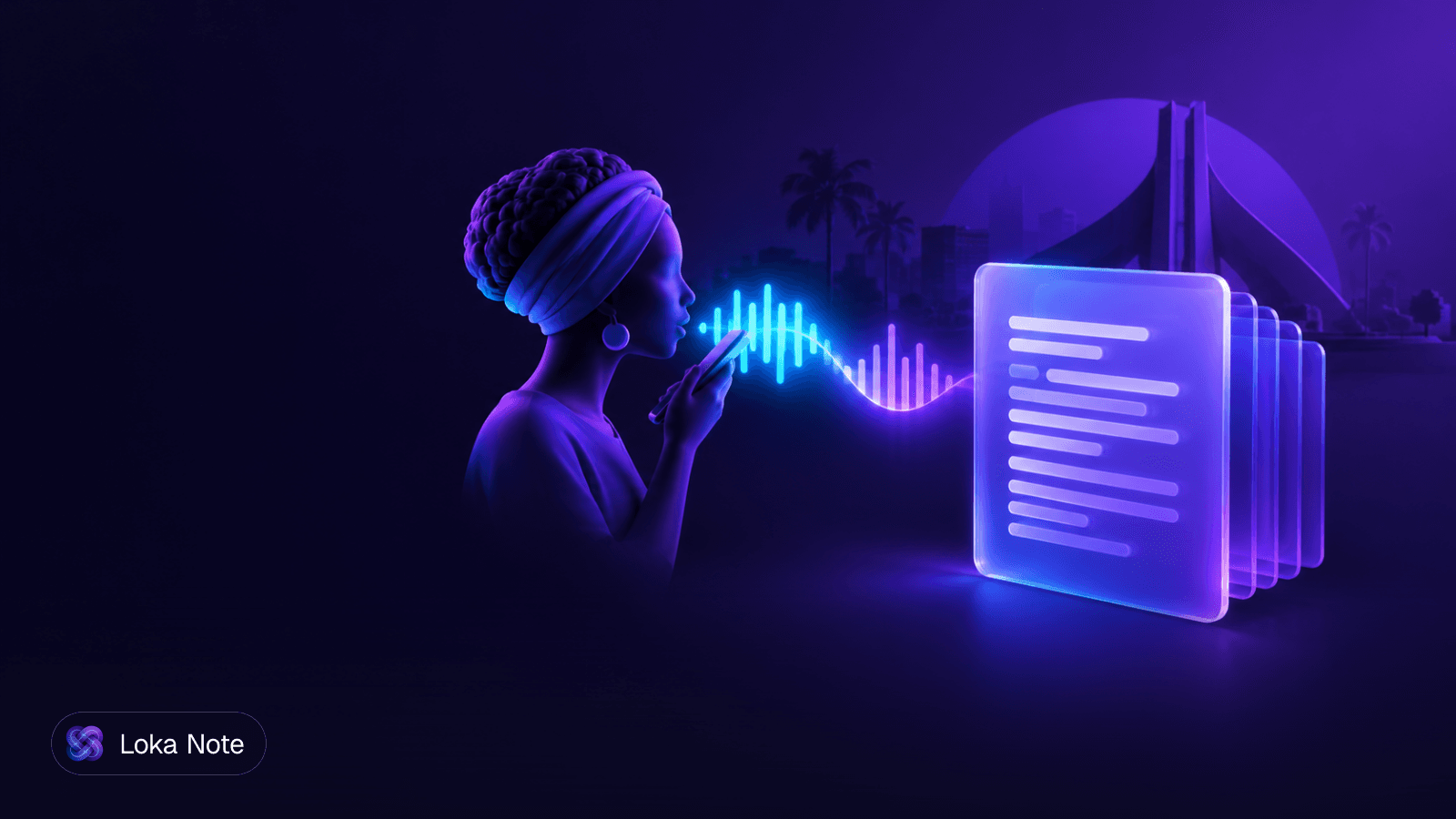
To get voice note to text Nigerian English results you can actually use, pick a tool trained on Nigerian speech and test it on your own recordings before paying. Generic transcription often handles clean, neutral-accent English well, then falls apart on compressed WhatsApp audio, regional accents and sentences that move between English, Pidgin, Yoruba or Hausa.
Below we compare six options, explain what goes wrong with standard tools, cover naira billing, and give a short test you can run in an afternoon.
Why Nigerian English voice notes trip up standard speech-to-text
Standard speech models are only as good as the speech they learned from, and Nigerian-accented English, phone-quality audio and local languages are often underrepresented. The errors are not random. They show up in the same places.
Three things stack up on a typical WhatsApp voice note:
- Accent and rhythm. Nigerian English has its own stress patterns, vowel sounds and phrasing. A model tuned mostly on other accents will mishear names, numbers and technical terms.
- Audio quality. Voice notes are compressed, and they are recorded in markets, cars and generator-noisy offices. Less detail in the audio means more guessing by the model.
- Language mixing. Real speakers do not stay in one language. More on that in the next section.
Does this mean the big tools never work? No. Some will do fine on a careful speaker in a quiet room. Your real audio is rarely that, so the only reliable answer is to test.
One data point on how much local tuning matters: Native AI, from ICIR, fine-tunes its speech recognition on Nigerian-accented English and reports about 30% lower word error rate than standard models. That is the vendor's own figure, so treat it as a reason to test, not a guarantee.
Code-switching: Pidgin, Yoruba and Hausa inside one sentence
Code-switching means a speaker changes language inside a sentence or between sentences, and a tool that assumes one language per recording will mangle the switch. This is the most common failure on real Nigerian business audio.
A typical example: someone starts in English about a delivery, drops a Pidgin phrase to make a point, then finishes in Yoruba. A model locked to English will try to spell the Pidgin and Yoruba as English-sounding words. The transcript looks fluent and is wrong.
Per-utterance versus per-token language detection
Tools handle this in different ways. Some detect one language for the whole file. Others detect per utterance. A smaller number label language at a finer level. Orinode's speech-to-text API, for instance, applies language identification labels per token rather than per whole utterance, which is the more direct way to follow a mid-sentence switch.
Autrans says it handles Nigerian English, Nigerian Pidgin, Yoruba, Hausa and Igbo with mid-sentence code-switching.
We have written about the same problem in another language pair. The causes are similar to those in why Burmese-English code-switching breaks transcription tools, and the general approach is covered in our multilingual meeting transcription guide.
What to check
Ask any vendor three things:
- Which languages are supported as separate options?
- Does the tool handle a switch inside one sentence, or only between files?
- Can you correct a transcript and re-run it where the language was misdetected?
Voice note to text Nigerian English: tools compared
The tools below are built for Nigerian speech or openly trained on it. The table summarises what each source says it offers. Accuracy on your audio is something only you can measure.
| Tool | Languages | Cost and payment | Best for |
|---|---|---|---|
| Autrans | Nigerian English, Pidgin, Yoruba, Hausa, Igbo | 30 free minutes per month on new accounts, no bank card; paid billing in naira | Forwarding WhatsApp voice notes and uploading recordings |
| Orinode STT | Hausa, Igbo, Yoruba, Nigerian English (en-NG), Pidgin (pcm) | ₦0.50 per second of audio, ₦25 minimum per request | Developers who want one API endpoint |
| Native AI (ICIR) | Nigerian-accented English, with translation into Hausa, Igbo, Yoruba | Not listed | Newsrooms and researchers working with accented English |
| Maraba | English, Hausa, Yoruba, Igbo, tuned on telephone-quality audio | Paystack billing, ₦20,000 to ₦65,000 per month | Call centres and phone-based support |
| SBPN models | Nigerian English, Pidgin, Yoruba, Hausa, Igbo | Open source, you supply the compute | Technical teams that want to run their own model |
| Loka Note | English, Yoruba, Hausa (plus Burmese, Thai, Vietnamese, Chinese) | Pay-as-you-go minutes in USD, from $1.99 for 60 minutes | Meetings and recorded calls that need summaries and action items |
A few notes on reading this table.
Autrans is the closest fit to the WhatsApp use case. You send the voice note where you already are and get text back.
Orinode is priced per second, which works out to ₦30 per minute, or ₦1,800 per hour of audio. The ₦25 minimum means a very short clip costs the same as one of roughly 50 seconds.
SBPN comes in two sizes: SBPN_multilingual_base at 120M parameters and SBPN_multilingual_large at 600M parameters. Both accept 16kHz mono audio, so files in other formats need converting first. That is a small job for an engineer and a barrier for everyone else.
There are also generic pages that list "English (Nigeria)" as a locale, such as Voiser's. Whether a generic locale option follows Pidgin or Yoruba mid-sentence is exactly what to test.
Paying in naira without a dollar card
For many Nigerian teams the blocker is not accuracy but checkout: a tool can be excellent and still unusable if it only takes foreign cards. Three of the tools above address this directly.
- Autrans gives new accounts 30 minutes of transcription free each month with no bank card, and bills paid usage directly in naira.
- Orinode prices its API in naira per second.
- Maraba offers Paystack billing starting at ₦20,000 to ₦65,000 per month.
Pay-as-you-go versus monthly matters as much as currency. If you transcribe a few voice notes a week, a per-minute or free-allowance model will usually cost far less than a monthly plan sized for a call centre. For a wider look at metered pricing, see our comparison of pay as you go audio transcription.
Loka Note is priced in US dollars. If naira billing is a hard requirement, the Nigerian tools above are built around that and we would start there.
Telephony and API options for support and sales teams
Phone calls are a different problem from voice notes, because call audio is lower in quality than a file recorded directly on a phone. If your audio comes from calls, pick a tool trained on call audio.
Maraba says its speech recognition engine is trained on telephone-quality audio from Nigerian callers across English, Hausa, Yoruba and Igbo. That is the relevant detail for a support or collections team. Orinode's single API endpoint suits teams that want to plug transcription into their own CRM or ticketing system.
Some teams only need transcripts of recorded calls, not live voice agents. If that is you, a batch transcription tool is usually simpler and cheaper than a full call-centre platform. Our post on sales call notes covers what to capture from a call once you have the text.
For anyone handling customer audio, also check where recordings are stored and who can use them. We list the questions in are AI note takers safe.
How to test a tool before you commit
Run the same set of recordings through every candidate and compare. Twenty minutes of audio is enough to see the pattern.
- Collect 5 to 8 real clips. Use actual WhatsApp voice notes, a phone call, and one noisy recording. Include at least two with code-switching.
- Write a reference for one clip by hand. Choose 60 seconds. This is your answer key.
- Run every tool on the same clips. Use the same files, not re-recordings.
- Mark errors by type. Count wrong names and numbers, wrong-language passages, and dropped sentences separately. A transcript that gets Pidgin phrases wrong may still be fine for your purposes. One that gets amounts wrong is not.
- Check the switch points. Look at exactly where the speaker changes language. This is where tools differ most.
- Check export and editing. Can you fix errors and download the result in the format your team uses?
- Do the maths on cost. Multiply your monthly minutes by each tool's rate, including minimums.
For a general walk-through of methods and trade-offs, see how to transcribe audio to text.
Which tool for which person
- Founder or manager with voice notes in WhatsApp: start with Autrans and its free monthly minutes.
- Developer building a product: try Orinode's API, or SBPN if you want to self-host.
- Journalist transcribing accented English interviews: try Native AI, and read our interview transcription guide for checking quotes.
- Call centre lead: test Maraba on real call recordings.
Where Loka Note fits
Loka Note is for recorded meetings and calls, not WhatsApp forwarding. It records in the browser with no bot joining, or accepts uploaded audio and video files, then produces a transcript, a summary, decisions and action items. It supports English, Yoruba and Hausa, among other languages, and handles mixed-language speech in a single meeting.
Two limits to know about. Nigerian Pidgin and Igbo are not among its listed languages, and it bills in US dollars. Run the test above on your own audio before relying on any tool, ours included.
What Loka Note adds is the layer after transcription. "Ask Loka" answers questions across all your past meetings, in your own language, from your own transcripts. There are no plan tiers. Top-up minutes start at $1.99 for 60 minutes and last 6 months, or you can pay $19.99 a month for unlimited use. Customer audio and transcripts are never used to train AI models, and the details are on our security page.
Try it on one real meeting recording: create an account
Frequently asked questions
Can AI transcribe WhatsApp voice notes spoken in Nigerian English?
Yes. Tools built for Nigerian speech, such as Autrans, let you forward a WhatsApp voice note or upload a recording and get a transcript back. Generic tools can also accept the audio file, but accuracy on Nigerian accents and phone-quality audio varies, so test with your own recordings first.
How do speech-to-text tools handle code-switching between Nigerian English, Pidgin and Yoruba?
Many generic tools pick one language for the whole recording, which causes errors when a speaker switches mid-sentence. Some Nigerian engines handle it directly. Orinode, for example, applies language labels per token rather than per utterance, and Autrans advertises mid-sentence code-switching across Nigerian English, Pidgin, Yoruba, Hausa and Igbo.
Which AI transcription tools accept naira payments without a dollar card?
Autrans offers billing directly in naira and a monthly free allowance with no bank card. Orinode prices its API in naira per second of audio. Maraba bills through Paystack. Check each tool's current checkout before relying on it.
Is there an open-source speech-to-text model for Nigerian languages?
Yes. The SBPN multilingual ASR models on Hugging Face come in a 120M-parameter base version and a 600M-parameter large version. They are trained on Nigerian English, Nigerian Pidgin, Yoruba, Hausa and Igbo and expect 16kHz mono audio. You need some technical ability to run them.
Why does speech-to-text misread Nigerian accents?
Models learn from the audio they were trained on, and Nigerian-accented English, Pidgin and tonal languages like Yoruba are often thin in that data. Phone-quality audio and background noise make it worse. Fine-tuning on Nigerian speech helps: Native AI reports roughly 30% lower word error rate than standard models.
Sources
- 1Autrans, AI Transcription for Nigerian Languagesautrans.online
- 2Nigerian Speech-to-Text API — Hausa, Igbo, Yoruba STT | Orinodemaraba.ai
- 3Frequently Asked Questionsnativeai.icirnigeria.org
- 4AI Call Center Nigeria — Hausa, Igbo, Yoruba and English | Marabamaraba.ai
- 5ogunlao/SBPN_multilingual_base · Hugging Facehuggingface.co
- 6English (Nigeria)voiser.ai
- 7ogunlao/SBPN_multilingual_large · Hugging Facehuggingface.co